
On winning and losing
A compelling account by a top athlete and property investor of what it feels like to win a lot and to lose a lot.
On a ski jumping hill there is a place called the critical point. It is the end of the steepest part of the landing slope, where the hill begins to flatten out. It is the line a jumper aims to clear. A short jump is safe but brings no success, while a jump that carries too far can end in a fall and an injury.
When a person meets their own critical point, they cannot avoid the question: what is left? What do I really rely on?
Samppa Lajunen has achieved a great deal both in sport and in investing, and has met severe disappointments in both. He rose from the scarcity of a recession to the top of Nordic combined and won three Olympic golds in Salt Lake City in 2002. After his sporting career a new arena began: entrepreneurship and investing.
The growth of the business was followed by the largest project of Lajunen’s career, the luxury hotel The Hotel Maria built in Kruununhaka in Helsinki. Amid the pandemic, war, inflation and financing difficulties the ambitious project ran into a crisis. The hotel was sold in 2025, and Lajunen had to face a loss of an entirely different order than any sporting defeat.
This is a story about winning and losing, and about what is left when medals, money and status no longer carry you.
The book deals with Samppa Lajunen’s life as it is: sport, working life, the media and the values one lives by. It also tells the founding story of Samla Capital and the company’s journey up to 2026.
We have described the company’s perspective on the same events separately on the page Transparency and lessons.
Details
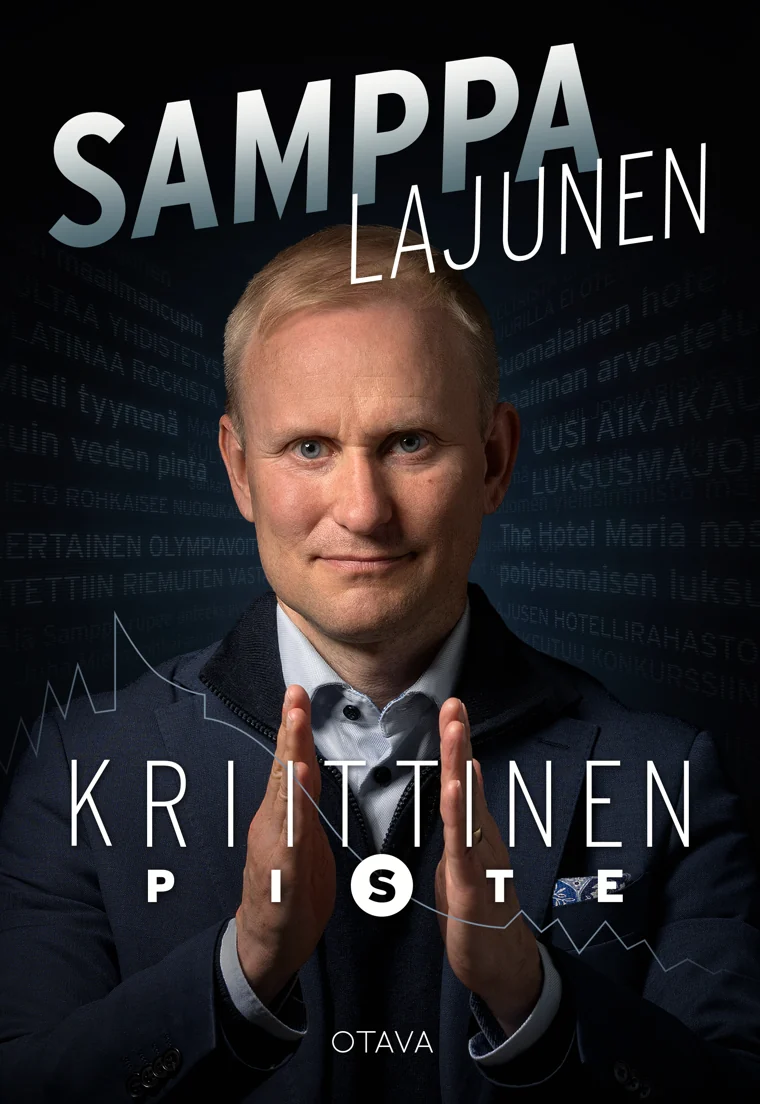
Kriittinen piste
Written by Janne Villa in collaboration with Samppa Lajunen
Published by Otava
Published 24 September 2026
In print, as an e-book and as an audiobook
ISBN 978-951-1-54402-9
The book is published by Otava and can be ordered from Finnish bookshops, for example Suomalainen Kirjakauppa.
It is dangerous to build your identity on individual wins or losses, on successes or failures. Inner peace has to be found independently of them.
Why this book?
Many people want to see writing a book as a commercial project, which it fundamentally is not. Others see writing a book as a way to gain visibility. Visibility as such has never been the goal. So why write a book that has no financial motive and no motive related to visibility?
I have come to the conclusion that the value of a life is better measured by what one can give to others than by what one can receive from them. This book is my way of sharing my own life with others.
For readers interested in sport, the book tells what the journey from recession-era Lieksa to Olympic gold demanded. For those in working life and entrepreneurship, I share my experiences of building a company, of investing, and of what a major loss feels like and what can be learned from it. The third theme of the book is faith and the values in life on which both sport and work have been built.
The fourth theme is the media. Working with the media has been part of my life since I was young. It came with elite sport as a given, and nobody asked whether I wanted it. Three Olympic gold medals in 2002 left a public mark that cannot be escaped, and later The Hotel Maria project led by Samla Capital caught the media's attention. The media told one perspective of what happened, but at the centre of events the picture looked broader. It was like two realities: what the media wrote, and what one saw and experienced with one's own eyes. In the book I wanted to address the role of the media as a force that affects real life, and to broaden the understanding of why the media writes what it writes.
One reader may be interested in sport, another in investing, another in the media, and another in life's other questions. If even one of my experiences gives a reader new insights into their own life, the book has done its job.
Samppa Lajunen
Something for Samppa Lajunen?
Messages sent with this form go to Samppa Lajunen personally, not to Samla Capital’s customer service. Use it for questions about the book or feedback on it, for speaking requests and for other personal contacts. Matters concerning Samla Capital, investing and media enquiries go through the contact page.