
The pike's jaws are open: wages rose, housing got cheaper
This article has been translated from Finnish with the help of automated translation. The Finnish original is the authoritative version.
The same salary buys a home almost 40 per cent larger or better today than ten years ago.

Illustration, produced with artificial intelligence
The same salary buys a home almost 40 per cent larger or better today than ten years ago. At the same time, the largest asset of Finnish households has become cheaper, while almost everywhere else in Europe it has become more expensive. The question is how the gap will narrow.
A pike does not chase its prey. It waits motionless in the reeds and chooses its moment.
The Finnish housing market now has its jaws open, and the jaws are two familiar curves: wages and housing prices. In economic writing, diverging curves like these are sometimes called crocodile jaws. For Finnish housing wealth, a domestic predator is a better fit.
The jaws have been open for four years.
Two curves that moved side by side
In the 2000s, housing prices followed wages. As earnings rose, homes became more expensive at roughly the same pace, and the ratio of prices to earnings stayed close to its 2015 level until 2022.
Then the jaws opened.
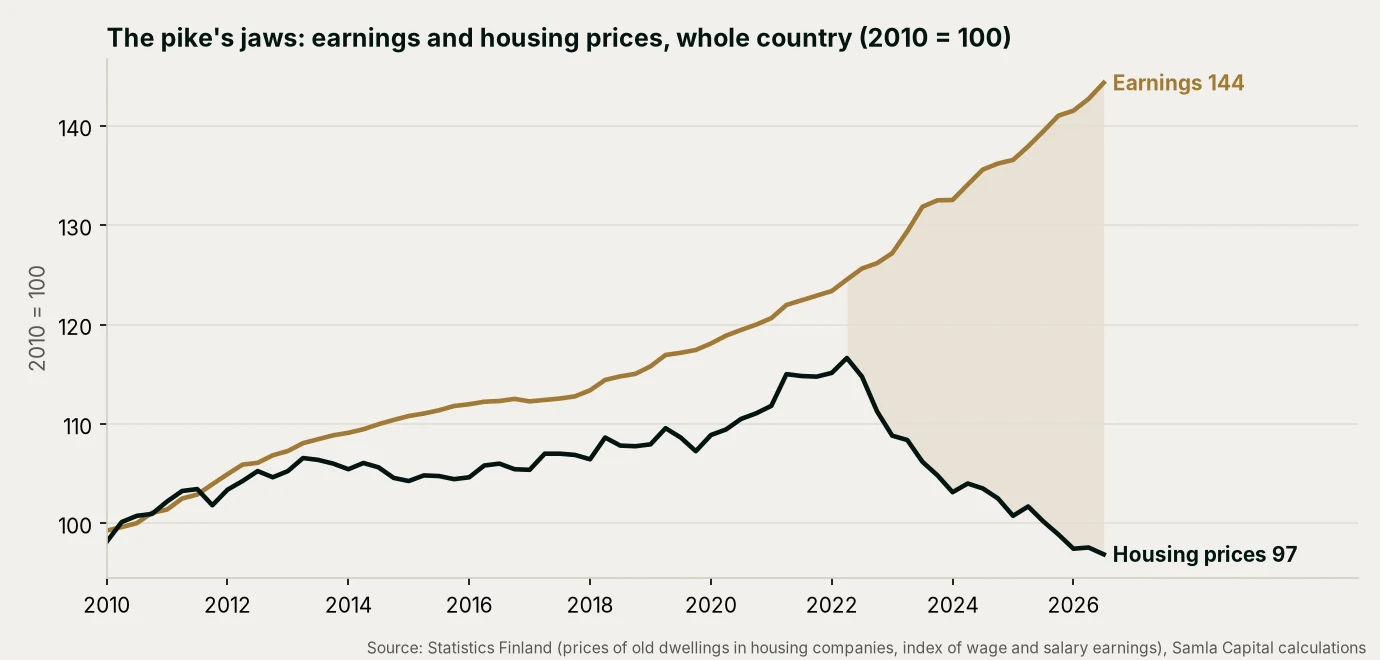
Since 2010, earnings have risen by 44 per cent in nominal terms, that is, before inflation. Over the same period, prices of existing housing-company flats have fallen by four per cent in nominal terms. From the 2022 peak, the fall is 17 per cent.
When the ratio of prices to wages is measured against its 2015 level (2015 = 100), the figure is now 72. That is the lowest since 2000. The same salary buys a home almost 40 per cent larger or better today than ten years ago.
For a buyer, the price is favourable. Servicing a loan is not as light, however, because interest rates have risen. The ratio of prices to wages is low, but for an investor the higher interest rate shows up as higher debt service costs.
The largest asset has sunk
Housing is by far the largest asset of a Finnish household. According to Statistics Finland, dwellings made up 61 per cent of households' total assets in 2023, and the household's own home alone accounted for 45 per cent. When the value of homes falls, household wealth falls with it.
The latest wealth survey by Statistics Finland is from 2023, and it only covers the beginning of the price decline. At that point, the typical value of a household's own home was 16.7 per cent lower in real terms than in 2019.
A comparison with other countries makes the picture starker. According to Eurostat's price indices, the real price of housing in Finland fell by a total of 22 per cent from 2015 to the second quarter of 2026. Over the same period, real prices rose by 5 per cent in Sweden, 19 in Norway, 35 in Denmark and 42 per cent in Estonia. Finland's performance is the weakest of all 26 EU countries for which data are available. Apart from Finland, real prices have fallen only in Italy and France. Among the Nordic and Baltic countries, Finland is the only one where real prices have fallen.
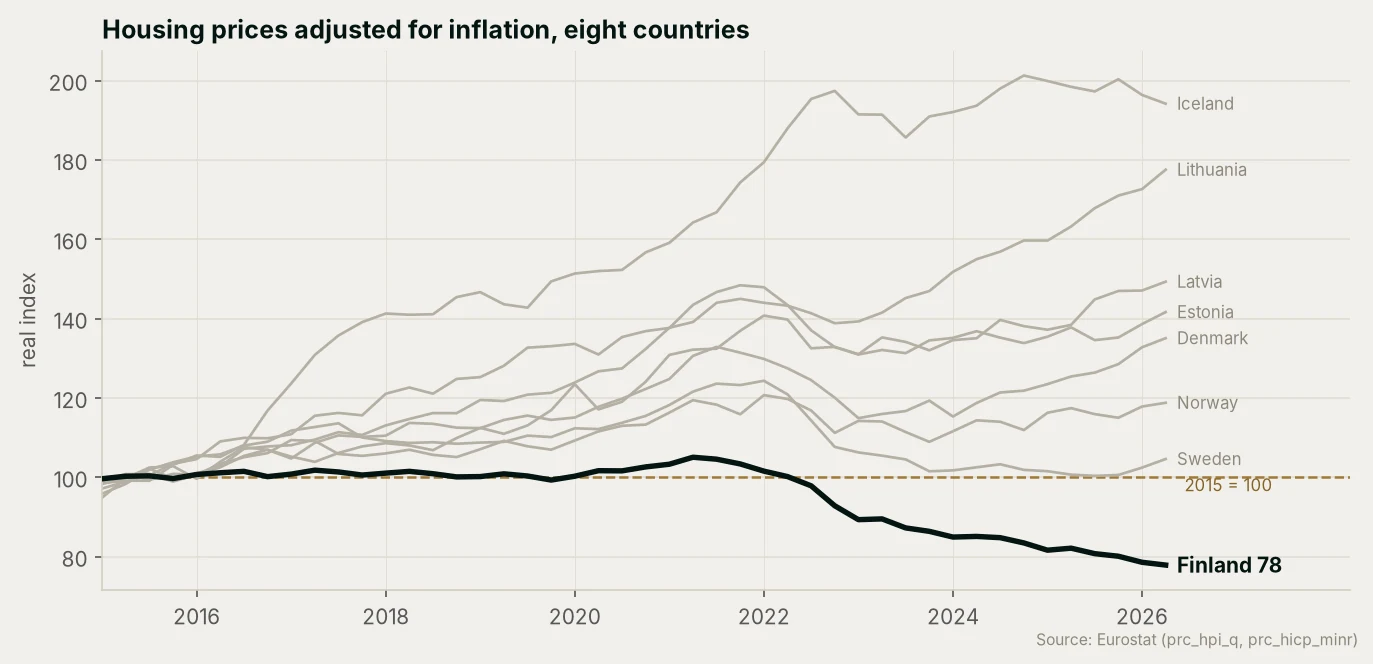
The most important asset of Finnish households, the value of their homes, has therefore developed clearly worse than almost anywhere else in the euro area. Roughly speaking, Finns have become poorer compared with other countries.
How will the jaws close?
The pike's jaws may close, but they may also stay closer to where they are now. Interest rates have risen, and a lower price level may be the new normal. The question is how the gap will eventually narrow, and at whose expense.
Will it narrow because the economy weakens? Then unemployment would rise and wage growth would slow. Unemployment was 10.4 per cent in September, and the 12-month number of bankruptcies is the highest in the series. Even so, according to the preliminary September data, earnings rose by 3.5 per cent year on year.
Or will the open jaws narrow as prices rise towards wages? At the moment, the data make a rapid rise in prices look unlikely. Besides the level of interest rates, housing prices are held back by weaknesses in the Finnish market: high unemployment, a large number of bankruptcies, a low birth rate and growing government debt.
Looking at history, the timing of a turn in prices is hard to predict. In Statistics Finland's long series, the ratio of housing prices to earnings was even lower than today after the recession of the 1990s; at its lowest, at the end of 1995, it was 68 (now 72, and the average since 1988 is about 97). We are therefore very close to the all-time low of the series. That gives hope for better times but does not guarantee a turn.
What can an investor learn from this?
The pike's jaws tell us two things.
The first is price. When a home costs less relative to wages than at any time this century, the starting point for prices is exceptional. A starting point is not the same as a return, however. Rents tell a different story from prices: Finnish rents are 5 per cent lower in real terms than in 2015, but prices have fallen even more. As a result, rent relative to price has improved. Of the seven Nordic and Baltic comparison countries, Finland is the only one where this has happened.
The second is risk. An investor relying on capital growth has already had to wait four years. An investment that relies on cash flow is less dependent on a turn in prices: the rent arrives every month, as long as the property is let and the tenant pays the rent. That is why a real estate investor who minimises risk first calculates whether the cash flow holds up. Only after that is it assessed what capital growth could add on top of the cash flow.
There are four risks. Interest rate risk is managed with moderate debt, interest rate hedging and staggered loan maturities. Letting risk is managed through the condition and location of the property and diversification of tenants. Because rents have fallen in real terms, the return must withstand that as well. Price risk is managed by not relying on capital growth for the return. Liquidity risk is real: selling a home takes time, and you cannot choose the price.
For an alert investor, open jaws can also be an opportunity. This summer my son caught a record-sized pike with a spinning rod on the lake by our summer cottage. The lure was small, but the pike was big. The flesh of a big pike did not taste very good, but the joy lasted a long time. The predator of the cottage lake had been caught.
Samppa Lajunen
Portfolio Manager, Samla Capital
Figures: Statistics Finland (price index of existing housing-company flats, index of wage and salary earnings, household wealth 2023, labour force survey, bankruptcies, building and dwelling production), Eurostat (house price index and consumer prices, Q2/2026), European Central Bank (household wealth accounts, experimental statistics), European Central Bank (Euribor). The ratio of prices to earnings (including the 1990s comparison) and the real changes in the ECB data are Samla Capital's calculations. Statistics Finland's figures cover existing housing-company flats and Eurostat's figures for Finland cover all dwellings. Figures for the third quarter of 2026 are preliminary. Past performance is no guarantee of future results, and the article is not investment advice.
Markkinapulssi brings together the leading indicators of the housing market once a month. Subscribe at samlacapital.fi/markkinapulssi.